Table of Contents
Why Budgets Work. And Why Most Small Business Budgets Fail
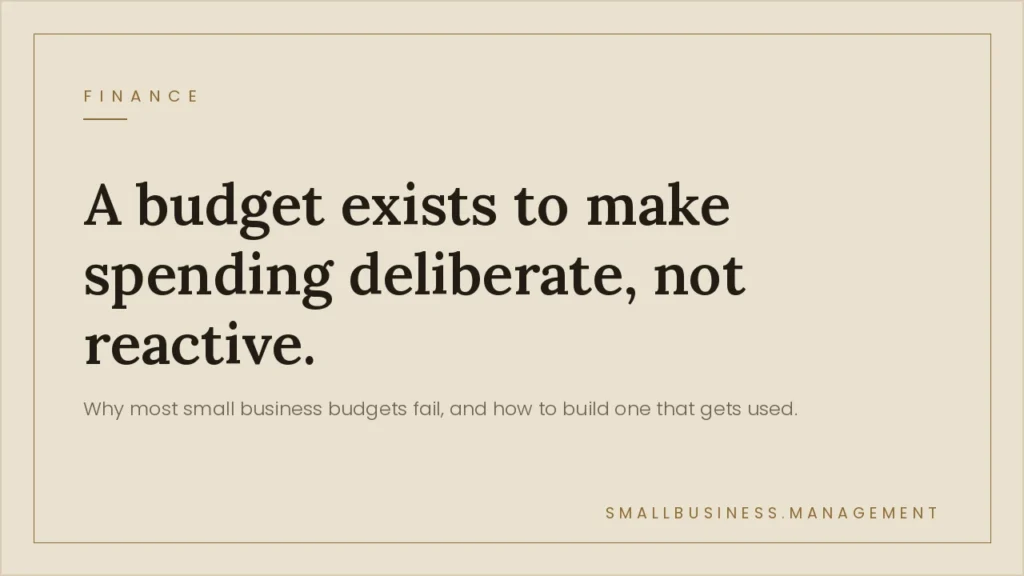
A budget is a spending and revenue plan stated in advance. Its purpose is not to restrict spending: it is to make spending decisions deliberately instead of reactively. Businesses without budgets do not spend less. They just spend without a reference point. When a surprise expense hits in October, there is no baseline that says whether it is absorbable or critical.
Most small business budgets fail because they are built once and never revisited. A static budget set in January against December assumptions is useless by March when a major client churns or a vendor raises prices. A budget reviewed monthly against actuals, a rolling budget, becomes a management tool instead of a filing exercise.
The 4 Budget Types Small Businesses Actually Use
| Budget type | How it works | Best for | Main limitation |
|---|---|---|---|
| Historical (incremental) | Last year’s actuals + growth/cut % | Stable businesses with predictable costs | Perpetuates inefficient spending patterns |
| Zero-based | Every line item justified from zero each year | Cost-cutting cycles, new businesses | Time-intensive. Difficult without good cost data |
| Rolling (12-month forward) | Add a new month as each month closes | Fast-growing or volatile businesses | Requires monthly discipline to update |
| Cash-based | When cash is received/paid, not when earned/incurred | Businesses with cash flow timing issues | Does not match accrual financial statements |
How to Build Your First Annual Budget in 6 Steps
- Pull 12 months of actuals from your accounting software. Export your P&L by month. This is your baseline. If you do not have 12 months of clean bookkeeping, building a budget is step two: getting your books clean is step one.
- Separate fixed costs from variable costs. Fixed: rent, insurance, salaries, subscriptions, loan payments, costs that do not change with revenue. Variable: COGS, contractor labor, commissions, shipping, advertising, costs that scale with activity. This distinction drives every major budget decision.
- Project revenue by channel or customer segment. Do not project “revenue”. As a single line. Break it into recurring contracts, expected renewals, new business pipeline, and seasonal variation. Revenue projections are only as good as the assumptions behind each segment.
- Calculate your break-even revenue. Total fixed costs divided by gross margin percentage. If your fixed costs are $15,000/month and your gross margin is 60%, you need $25,000/month in revenue before making a dollar of profit. Know this number before every major spending decision.
- Set targets, not just baselines. A budget should include both what you expect to spend and what you are targeting as profit. Define a profit target (10%, 15%, 20% of revenue) and work backward to what revenue and cost structure delivers it.
- Schedule a monthly budget review. 30 minutes. Actual vs. budget variance by line item. Flag anything more than 10% off-plan. This meeting is where the budget does its work: not during construction.
Ready to manage cash flow alongside your budget?


