Table of Contents
Why Vendor Costs Creep: The Mechanics of the Problem
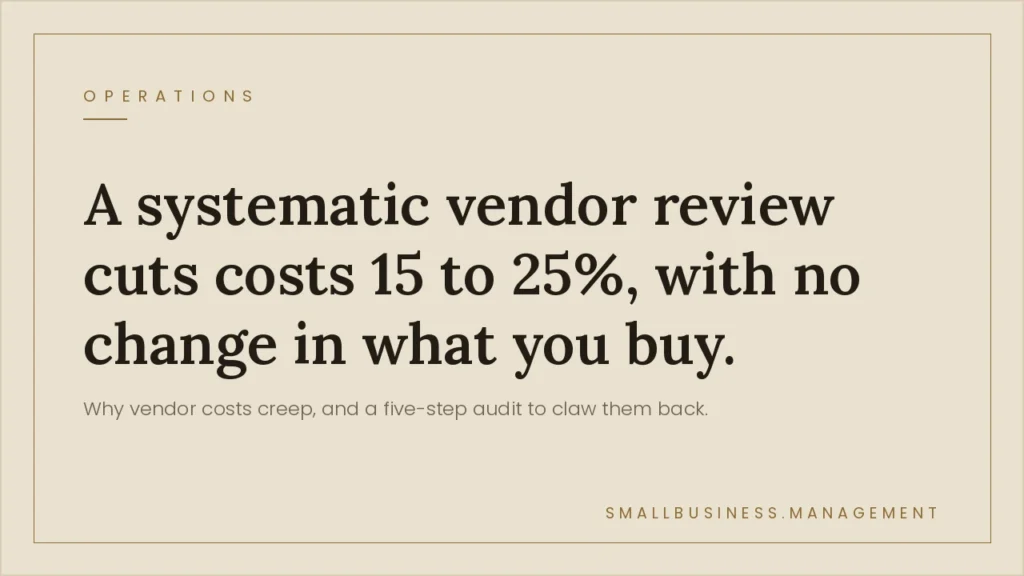
Vendor costs increase for three reasons in small businesses: automatic price escalations built into contracts that no one tracked, unused tiers and features that were purchased speculatively and never used, and the accumulation of redundant tools that were added over time and never audited against each other. None of these require a bad vendor or a negligent owner. They require only the passage of time and the absence of a systematic review process.
The most reliable indicator of vendor cost creep is a growing software expense line on the P&L relative to revenue. A business that added 12 SaaS tools over 3 years without ever canceling one has almost certainly accumulated $3,000–$8,000 per year in subscriptions it no longer uses or needs. A physical product business that has not requested competitive quotes from suppliers in two years has almost certainly drifted above market pricing. Both are recoverable with a focused audit.
Vendor Cost Reduction by Category
| Vendor category | Common cost leak | Reduction approach | Typical savings |
|---|---|---|---|
| SaaS / software subscriptions | Unused seats, unused tools, over-tiered plans | Audit monthly. Cancel unused. Downgrade tier | $200–$3,000/yr |
| Insurance (commercial) | No re-quote since original policy. Coverage gaps or over-coverage | Annual broker re-quote. Coverage audit | 5–15% of premium |
| Payment processing | Default rates not renegotiated. Wrong pricing model for transaction volume | Rate review at $50K+/mo processing volume | 0.2–0.5% on volume |
| Supply / materials vendors | No competitive quote in 2+ years. No volume consolidation | Annual RFQ to 2–3 competitors. Consolidate spend | 5–20% of category spend |
| Professional services | Scope expansion without rate review. No competitive benchmark | Annual engagement review. Benchmark against market | 10–25% of category spend |
| Telecom / internet / utilities | Promotional rates lapsed. Better plans available | Annual comparison shopping. Retention call | $100–$500/mo |
Conducting a Vendor Cost Audit: 5 Steps
- Pull a complete vendor list from your bank and credit card statements. Export 12 months of business bank and credit card transactions. Filter for recurring charges. You are looking for: monthly/annual subscriptions, service retainers, supplier invoices, and any other periodic payments. For most small businesses, this exercise produces a list of 30–60 vendors, including several that the owner cannot immediately identify. Unidentifiable charges are the first candidates for cancellation.
- Categorize each vendor as critical, useful, or questionable. Critical vendors are those where cancellation would immediately disrupt operations. Useful vendors provide value but have alternatives. Questionable vendors are those where you cannot articulate the value received in the last 90 days. Every questionable vendor gets canceled unless someone can make an affirmative case for keeping it. The default for “I’m not sure we use this”. Is cancel: not wait and see.
- Request competitive quotes for your top 3 expense categories. For the three highest-dollar vendor categories in your business, request quotes from two competing providers. You do not have to switch: the quote is a data point and a negotiating position. Send your current vendor the competitive quote and ask whether they can match or improve it. This works reliably for insurance, supply vendors, telecom, and professional services. It works less reliably for SaaS products with high switching costs.
- Renegotiate with current vendors before considering a switch. Most vendors have room to negotiate that they will not offer until asked. The opening is simple: “We are reviewing all vendor contracts this year as part of our annual budget process. We value the relationship, and I want to give you the opportunity to remain competitive before we explore alternatives.”. Asking for a better rate, a higher discount tier, or a contract restructuring is not a threat: it is a normal business conversation that vendors expect from customers who are paying attention.
- Set auto-reminders for every contract renewal date. Most vendor cost creep happens at renewal: the contract auto-renews at a higher rate, or a promotional price lapses, or a tier changes. Put every vendor renewal date in your calendar 60 days before the renewal. Sixty days is enough time to request a competitive quote, conduct negotiations, and make a switch if needed. Thirty days is usually not enough, especially for vendors with longer cancellation notice requirements.
Putting vendor savings back into a disciplined financial plan?


