Small Business Loans: Types, How to Qualify, and Common Mistakes

Small business loans come in several distinct types, each designed for a different use case and each with different qualification standards, rates, and terms. Choosing the wrong type costs you money. Applying without understanding what lenders need wastes time. This guide covers the main loan types, what it takes to qualify, and the mistakes that sink first-time applicants.

Types of Small Business Loans

The SBA 7(a) loan is the most widely used small business loan program in the United States. It covers up to $5 million and can be used for working capital, equipment, real estate, business acquisition, or refinancing existing debt. The SBA guarantees a portion of the loan, which reduces the lender’s risk and allows approval for businesses that might not qualify for a conventional bank loan on the same terms. Variable and fixed rates are both available, with SBA rules capping the maximum rate a lender can charge. Terms run up to 10 years for working capital and equipment and up to 25 years for real estate.

The SBA 504 loan is structured differently. It finances major fixed assets: owner-occupied commercial real estate, construction, and large equipment. The structure involves a bank providing roughly 50 percent of the project cost, a Certified Development Company providing about 40 percent backed by an SBA debenture, and the borrower contributing 10 to 15 percent. The CDC portion carries a long-term fixed rate, often out to 25 years. For businesses acquiring or building real estate, the 504 typically produces better terms than a conventional commercial mortgage.

SBA Microloans are available for amounts up to $50,000, delivered through nonprofit community lenders approved by the SBA. They work for working capital, inventory, supplies, and equipment, but cannot be used for real estate or to refinance existing debt. Credit standards are often more flexible than the larger SBA programs, and the nonprofit intermediaries frequently provide technical assistance alongside the financing.

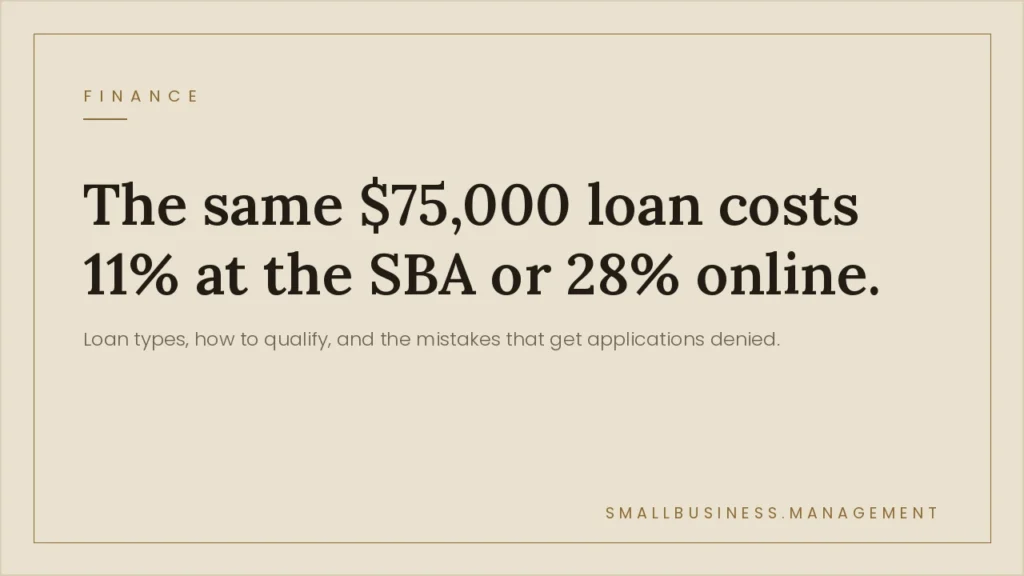
Conventional term loans from banks, credit unions, and online lenders provide a lump sum repaid over a fixed period. Approval is generally faster than SBA programs, but credit and collateral requirements are stricter for bank lenders. Online lenders are more accessible for businesses that cannot meet bank standards, at meaningfully higher rates.

Equipment financing uses the equipment itself as primary collateral and is available through both SBA channels and conventional lenders. Terms align with the useful life of the equipment, and lenders often finance 100 percent of the cost because the collateral is the asset being purchased.

How to Qualify

For SBA loans, the business must be for-profit, U.S.-based, and meet SBA size standards for the relevant industry. The owner must have invested equity, the business must demonstrate the ability to repay from operations, and there must be no outstanding defaults on federal debt. The SBA guarantees a portion of the loan, but the bank or approved lender underwrites and funds it. The lender’s criteria layer on top of SBA eligibility requirements.

Time in business is a common filter. Most 7(a) and 504 lenders prefer at least two years of operating history. Startups have a harder path and typically need a strong business plan, demonstrated industry experience, and solid personal credit to compensate for the absence of business track record.

Equity injection requirements apply to most SBA loans. Expect to contribute 10 to 20 percent of the project or loan amount from your own funds. This demonstrates owner commitment and reduces the lender’s exposure.

Credit Score Expectations

SBA 7(a) lenders typically look for a personal FICO of at least 640, with meaningfully better approval odds and terms available at 680 and above. SBA 504 programs sometimes accept slightly lower scores because the real estate or equipment collateral is strong. Microloan intermediaries may go lower if the business fundamentals and owner commitment are compelling.

Conventional bank term loans and equipment loans generally expect good to excellent credit, roughly 680 to 700 and above, for competitive rates and standard approval. Borrowers with weaker scores are often referred to SBA programs or online lenders, both of which carry higher costs. Business credit history, built through trade accounts and any existing business credit cards, is reviewed alongside the personal credit score.

Collateral and Personal Guarantees

SBA 7(a) lenders are required to take all available collateral for larger loans. Business assets are pledged first. Personal real estate may also be required. All owners with 20 percent or more equity in the business must sign a personal guarantee, making them personally liable for repayment if the business cannot pay.

SBA 504 loans are generally secured by the project assets themselves. The real estate or equipment being financed serves as the collateral. Outside collateral is typically not required. The borrower’s 10 percent equity contribution replaces the larger down payment that a conventional commercial real estate lender would require.

Personal guarantees are standard across nearly all small business lending. Even with strong collateral, a lender extending credit to a small business will expect the owner to stand behind the obligation personally. This is not negotiable in most cases.

Where to Apply

SBA 7(a) loans are available through SBA-approved banks, credit unions, and non-bank lenders. The lender you choose matters. SBA Preferred Lenders have delegated authority to approve loans without waiting for SBA review, which speeds the process significantly. If time is a factor, apply through a Preferred Lender.

SBA 504 loans are structured through Certified Development Companies working in partnership with a participating bank. Find a local CDC through the SBA’s website. They will pair you with a bank and structure the deal.

SBA Microloans go through nonprofit intermediaries. The SBA’s website lists approved intermediaries by state. Many of these organizations also offer business counseling, which can be useful for a first-time borrower preparing financial statements and projections for the first time.

Your existing bank relationship is worth starting with for conventional term loans. A bank that already holds your business accounts has transaction history that supplements your application. Online lenders are faster and more accessible but carry higher rates. Use them when speed matters or when you cannot qualify at a bank, not as a default first choice.

Mistakes That Kill Loan Applications

Applying without a complete financial package is the most common mistake. Lenders reviewing an incomplete application will either request missing items, which delays everything, or decline outright. Prepare two years of business tax returns, year-to-date financials, three to six months of bank statements, and a clear explanation of how you will use the funds before submitting anything.

Mismatching the loan type to the need is expensive. Using a short-term, high-rate online loan to fund a long-term asset purchase costs far more than it should. Similarly, choosing a flexible 7(a) when a lower-rate 504 fits the real estate project means overpaying on interest. Map the use of funds to the loan structure before choosing a product. Map the use of funds to the loan structure before choosing a product.

Applying under financial stress shows up in the underwriting. Bank statements with consistent overdrafts, declining revenue trends, or a cash position that is already thin signal to a lender that the loan may not be repaid. Apply when your financials show stability or growth, not when you have already run out of options.

Accepting predatory terms because approval seems uncertain is a risk worth naming explicitly. Loans with undisclosed fees, unclear effective APRs, or pressure to sign quickly before reviewing terms are structures designed to benefit the lender at the borrower’s expense. Compare at least two offers before accepting any small business loan.

author avatar
The SBM Editorial Team
Practitioners with 15+ years helping small businesses manage operations, cash flow, and growth.
Scroll to Top