Table of Contents
HR Outsourcing for Small Business: What It Is and When It Makes Sense
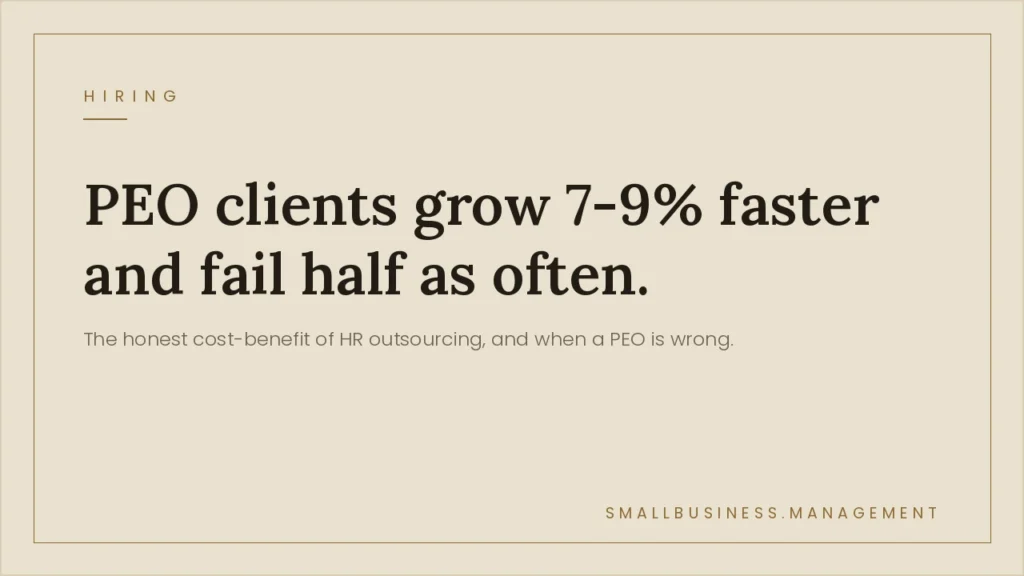
HR outsourcing for small businesses takes two primary forms: a Professional Employer Organization (PEO), which assumes co-employer status and handles payroll, benefits, compliance, and HR administration through a shared employment relationship. And HR service providers, which handle specific HR functions: payroll processing, benefits administration, compliance support: without the co-employer structure. The PEO model is the more comprehensive option and typically the better value for businesses between 5 and 50 employees.
The honest cost-benefit analysis of HR outsourcing turns on one number. The health insurance savings. For most small businesses. The PEO cost ($100–$165 per employee per month) is partially or fully offset by the reduction in health insurance premiums the PEO’s group rates produce. A business paying $600 per employee per month for individual health insurance that can reduce that to $420 through a PEO has captured $180 per employee per month in savings: which covers or exceeds most PEO fees before any compliance or administrative value is counted.
PEO vs. In-House HR: Annual Cost Comparison at Different Headcounts
PEO Cost-Benefit Calculator
PEO vs. HR Software vs. HR Outsourcing: When to Use Each
| Model | What it covers | Cost range | Best fit | Key limitation |
|---|---|---|---|---|
| PEO (co-employer) | Full HR outsourcing: payroll, benefits (group rates), compliance, workers’. Comp, HR admin support | $100–$165/emp/mo | 5–50 employees. Health insurance savings are material. Owner wants to offload HR entirely | Co-employer structure limits control. Minimum employee counts. Contract commitments |
| HR software only | Payroll automation, PTO tracking, onboarding, employee records: owner still makes all HR decisions | $4–$12/emp/mo | 1–25 employees. Owner can manage HR decisions. Primarily needs admin automation | No compliance support. No benefits buying power. Owner retains all HR liability |
| Payroll service only | Payroll processing and tax filing only. HR admin remains manual | $50–$150/mo + fees | Businesses that only need payroll compliance handled. HR admin is minimal | No HR administration. No benefits. No compliance support outside payroll |
| HR consulting + software | HR software for admin + periodic HR consultant for compliance issues and policy development | $4–$12/emp/mo + $150–$300/hr consulting | 10–50 employees. Need occasional HR expertise but not full outsourcing cost | Reactive rather than proactive compliance. No benefits buying power |
| In-house HR staff | Dedicated HR employee managing all HR functions internally | $55,000–$85,000/yr salary + benefits | 50+ employees. HR complexity justifies dedicated staff. Benefits administration is manageable internally | High fixed cost. Single point of knowledge dependency. Benefits purchasing at individual-business rates |
Evaluating HR Outsourcing and PEO Providers: 5 Steps
- Get a binding health insurance quote before evaluating the PEO’s other services. The health insurance rate is the primary economic variable in the PEO decision. Request a specific quote for your employee demographics, age, family status, location, from any PEO you are seriously considering, and compare it to your current carrier’s rates. This comparison tells you whether the PEO is cost-neutral, cost-positive, or cost-negative for your specific team before you evaluate compliance support, HR tools, or service quality.
- Verify the PEO is IRS-certified and ESAC-accredited before considering it further. The IRS offers a CPEO (Certified Professional Employer Organization) designation that verifies the PEO meets federal standards for tax compliance and financial solvency. The Employer Services Assurance Corporation (ESAC) accreditation provides additional financial and compliance verification. A PEO without both credentials carries higher risk of financial instability or tax non-compliance: which becomes your problem as the client business. Major accredited providers include Justworks, TriNet, Insperity, and ADP TotalSource.
- Understand the contract terms before signing: particularly minimum commitments and termination provisions. Most PEOs require annual contracts with 30–60 day termination notices and may charge early termination fees. Switching PEOs mid-year requires employee re-enrollment in new benefits, which is disruptive. Before signing, understand: what is the minimum employee count, what happens to benefits if you terminate the contract, how are workers’. Comp claims handled if you leave, and what data do you own if you switch platforms. These terms matter significantly if the relationship does not work out.
- Evaluate the service model, dedicated HR support vs. call center, based on how often you will actually need help. Some PEOs provide a dedicated HR representative who knows your business. Others route all support through a general call center. For businesses with 5–15 employees, a general support model is usually adequate. HR questions are infrequent and relatively routine. For businesses with 20+ employees, complex benefits situations, or multi-state workforce complications, a dedicated contact who knows your business provides meaningfully better support quality. Ask specifically how support is structured before selecting a provider.
- Run the PEO’s onboarding process against your own deadlines before committing. PEO onboarding: migrating payroll, re-enrolling employees in benefits, setting up the HR platform: takes 4–8 weeks for most providers. If you are trying to hit an open enrollment deadline or address a specific compliance issue, confirm the PEO’s onboarding timeline before assuming it will be solved in time. Many PEOs have a quarterly or annual benefits enrollment cycle: joining mid-year may mean employees stay on their current plan until the next enrollment window.
Building the HR and people management system your growing business needs?


