Accounts Receivable: The Silent Cash Flow Crisis
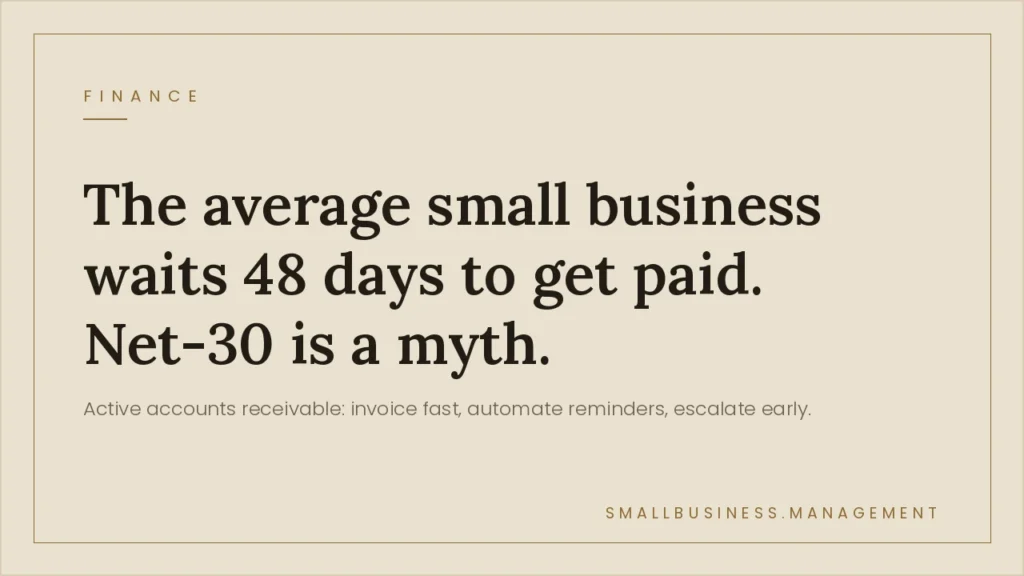
Accounts receivable management is the process of systematically tracking, following up on, and collecting outstanding invoices before they become bad debt. Most small businesses treat AR as a passive process. Send the invoice, wait, hope. That approach leaves 20-30% of receivables paid late and a predictable cash gap every month.
Active AR management treats collections as a system. Invoices sent immediately, payment reminders automated, escalation triggers defined, and every open balance visible in a weekly review. Businesses that systematize AR typically cut their Days Sales Outstanding by 10-15 days: on $500K in annual revenue, that is $14,000-$21,000 in additional working capital freed without borrowing anything.
The 5-Step AR Collection System
- Invoice immediately: not at month-end. Invoice the same day work is complete or goods are delivered. Every day between delivery and invoicing is a day your customer is not on the payment clock. Month-end batch invoicing turns net-30 into net-45 by default.
- Send an automated reminder at net-25. Five days before the due date, send an automated payment reminder. Frame it as a courtesy, not a collection. “Your invoice for $4,200 is due in 5 days. Pay online here: [link].”. This reminder alone reduces late payments by 20-30%.
- Call (do not just email) at net-35. When an invoice is 5 days past due, a phone call resolves it in 80% of cases. “I’m following up on invoice #1042: do you have any questions about it?”. Most late payments at this stage are administrative delays, not refusals. Email is too easy to ignore.
- Escalate at net-60 with a formal demand. At 30 days past due, send a formal notice: the invoice amount, the original due date, a new payment deadline (5-7 days), and the consequence (account hold, interest per your contract, or collection agency referral). Most clients pay on this notice.
- Make a collection decision at net-90. At 60 days past due, decide: small claims court (effective for invoices under $10,000 in most states), a commercial collection agency (typically 25-40% contingency on collected amount), or write off the loss. Do not continue delivering services to clients with invoices 60+ days outstanding.
| AR tool | What it automates | Cost | Best for |
|---|---|---|---|
| QuickBooks / Xero reminders | Automatic past-due email sequences | Included in subscription | Businesses already using QBO or Xero |
| FreshBooks | Auto-reminders + online payments + late fees | $19+/mo | Service businesses with frequent invoicing |
| Invoiced.com | Full AR automation, dunning, reporting | $100+/mo | Businesses with $500K+ in annual invoicing |
| Stripe Invoicing | Online payment + auto-reminders | 0.4% per invoice paid | Businesses wanting card/ACH payments on invoices |
Managing AR as part of a broader cash flow strategy?


