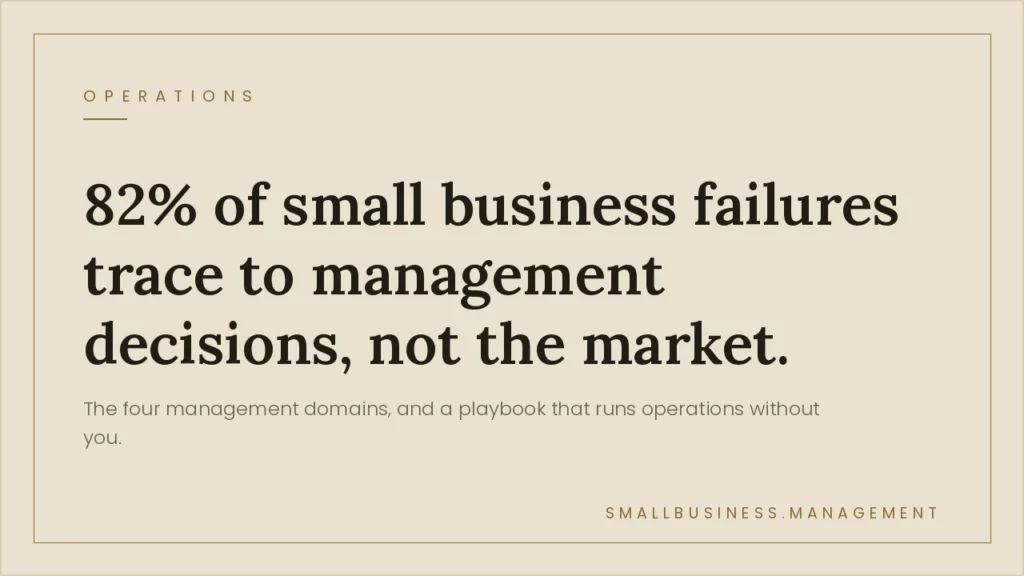
Small Business Management Playbook: How to Build Operations That Run Without You

Most small businesses do not fail because the owner lacked drive. They fail because there was no system behind the effort. Work gets done, but it depends on the owner remembering everything, the right person being available, and nothing going wrong at the same time. That is not a business. That is a daily rescue operation.

This playbook fixes that. It is a practical framework for building operations that run on process rather than personality. You do not need a COO on payroll to use this. You need the same thinking a COO brings, applied to your business at your scale and budget.

What a Management Playbook Actually Is

A management playbook is a single reference that captures how your business runs. It answers three questions: what work needs to happen, who owns it, and how it gets done. When those three questions have documented answers, the business stops depending on any one person to hold it together.

This is not a policy manual. It is not a binder of procedures that no one reads. A useful playbook is short, specific, and tied directly to the work your team does every day. The goal is to create a document that your newest hire can open on day one and understand what is expected of them and of everyone around them.

Most SMBs never build one because it feels like administrative overhead. It is not. It is the difference between a business that scales and one that stalls at the owner’s capacity ceiling. At 10 employees, you can survive without it. At 20, you start to feel the absence. At 30, the cracks become structural.

Step 1: Define Your Operating Model Before You Document Anything

Before documenting anything, get clear on what your business is actually trying to do operationally. That means three to five measurable operational goals, not a mission statement. Examples: deliver all client projects within five business days, maintain a gross margin above 45%, respond to every inbound inquiry within two hours, and keep returns below 2%.

These goals become the filter for every operational decision. When you are deciding whether to add a process, buy a tool, or hire a role, the question is simple: does this move one of those numbers?

Without this clarity, playbooks become bureaucracy. With it, they become a competitive asset. Spend one hour on this step before touching anything else. Write the goals down, share them with your leadership team, and make sure everyone agrees that these are the right measures of operational success.

Step 2: Map Your Core Workflows

Every business has four to six workflows that drive everything else. For most SMBs, those are: lead handling, quoting or sales, delivery or fulfillment, invoicing and collections, and customer support. Add hiring and onboarding if you have more than five people on the team.

Map each one end-to-end. Start with the trigger (an inbound call, a signed contract, a new hire’s first day) and end with completion (payment received, project closed, employee reaching full productivity). For each step, note who does the work, how long it should take, and what the output looks like.

This exercise exposes three things that are invisible when work just gets done: where work piles up. Steps depend on a single person who cannot be replaced, and where quality is inconsistent across team members. Those three findings tell you exactly where to build first. Do not skip this step to jump straight to writing procedures. You will document the wrong things.

Step 3: Write SOPs for Your Ten Most Critical Tasks

A standard operating procedure does not need to be a ten-page document. The most effective ones fit on a single page or a short checklist. Each one answers five questions: what is the task, who owns it, what triggers it, what are the steps in order, and what does done look like.

Start with the ten highest-impact recurring tasks. For most SMBs, those are: responding to inbound leads, sending proposals or quotes, onboarding new clients, delivering the core service or product, handling support requests. Invoicing, collecting payment, onboarding new hires, closing out completed work, and reviewing weekly performance numbers.

Write those first ten. Once those are documented, delegation becomes possible. Until then, it is not. Trying to delegate without SOPs results in inconsistent outcomes and frustrated owners. The SOP is what makes delegation stick.

One practical approach: sit with the person who currently does each task and capture what they actually do, not what the process is supposed to be. The gap between those two things is often the source of your biggest operational problems.

Step 4: Set the Metrics That Matter

Five to eight metrics cover the territory for most small businesses. The right ones depend on your model, but a solid baseline includes: output volume per week, error or rework rate, cycle time from order to delivery, client satisfaction score, and current cash position. Add one or two that are specific to your industry or service.

Define how each metric is measured, who pulls the data, and how often it is reviewed. Weekly for operational metrics. Monthly for financial ones. The discipline is not in picking the right metrics. It is in reviewing them on a fixed schedule and making decisions based on what they show rather than gut feel.

Metrics without a review cadence are just data-collection exercises. With a regular review, they become a management system. The review does not need to be long. A 30-minute weekly check against five numbers is enough to catch problems before they become expensive.

Step 5: Reduce Owner Dependence

This is the actual purpose of the playbook. Every decision that requires the owner’s direct involvement is a bottleneck. Every task that only one person knows how to do is a single point of failure. A documented system shifts the business from founder-run to system-run, which is the operational prerequisite for growth past the owner’s personal capacity ceiling. Every task that only one person knows how to do is a single point of failure. A well-built operations playbook removes both over time.

The test is simple: if the owner took two weeks off with no phone access, what would break? List those things. Document them first. Then list the next tier of dependencies. Within six months of consistent work, the business should be able to operate for two weeks without the owner making any day-to-day decisions.

This is not about working less. It is about building the operational capacity to grow past the current revenue ceiling. Most businesses hit their ceiling not because the market stopped growing but because the owner ran out of hours. The playbook is how you break through that ceiling without burning out.

Step 6: Choose Tools That Support the System

Tools follow the process. The mistake most SMBs make is buying software to solve an operational problem before defining the process the software is supposed to support. The result is underused tools and workarounds layered on top of workarounds.

The minimal useful stack for a small business: one work management tool for tracking tasks and projects, one CRM for managing leads and clients, one accounting system. One platform to store SOPs and reference documents (tools like SweetProcess, Scribe, or Trainual are built specifically for this). Four tools, each with a clear purpose, are integrated in a way that saves meaningful time.

Before adding any tool, identify the specific process failure it is supposed to fix. If you cannot name the process failure, do not buy the tool. Technology does not create operational discipline. It either supports existing discipline or adds complexity to an already undisciplined system.

Step 7: Build a Continuous Improvement Cadence

The playbook is not finished when you write it. It becomes a real management system when it has a review cycle.

Weekly: review the five to eight operational metrics and identify what moved and why. Monthly: review financials, capacity, and any SOP that generated errors or confusion in the previous 30 days. Quarterly: review the playbook structure itself, add new SOPs for processes that have grown in complexity, and retire ones that are no longer relevant to how the business operates.

Involve the people doing the work in this process. They see friction first. The owner sees it last. SOPs built without frontline input are accurate on the day they are written and wrong six months later. Schedule a 30-minute team review each quarter to update procedures based on what people actually encounter on the job.

A 12-Month Roadmap to Operational Independence

Months one and two: define the three to five measurable operational goals, map the five core workflows, and identify the top three bottlenecks. Months three and four: write SOPs for the ten highest-impact recurring tasks, assign clear owners, and start the weekly metrics review. Months five and six: implement or consolidate tools, connect them to documented processes, and eliminate tools that do not serve a documented process. Months seven through nine: introduce monthly operations reviews, start automating the most repetitive steps, and refine metrics based on what you are learning. Months ten through twelve: expand SOP coverage, formalize onboarding using the playbook, run the two-week owner-absence test.

Twelve months of consistent effort produce a business that does not require the owner to be physically present for daily operations to run well. That is not a luxury. For any business planning to grow past its current size, it is a requirement.

Common Mistakes That Derail Playbook Projects

The most common failure is writing SOPs that describe how work is supposed to happen rather than how it actually happens. The second most common failure is treating the playbook as a one-time project instead of a living system. The third is trying to document everything at once instead of starting with the ten highest-impact tasks and expanding from there.

Perfection is the enemy of a working playbook. A rough SOP that the team actually uses is worth more than a polished document that lives in a shared drive no one opens. Build for use, not for appearance.

When to Bring in Outside Help

Some of this work is straightforward to do internally. Other parts require someone who has seen enough operations to know what good looks like and where the blind spots are. An operations consultant is most useful at two specific moments: when you are mapping workflows and cannot see your own inefficiencies, and when you have hit a growth ceiling and cannot identify the operational cause.

Outside help does not replace doing this work. It compresses the timeline and helps you avoid building systems that look right on paper but do not solve the underlying problem.

If your business has been stuck at the same revenue or headcount ceiling for more than 12 months, the ceiling is likely operational. The fix is a management system built on the framework above.

World Consulting Group works with SMBs at this exact stage. If you want an outside view of where your operations stand and what to fix first, get an advisor evaluation here.

author avatar
World Consulting Group
Scroll to Top