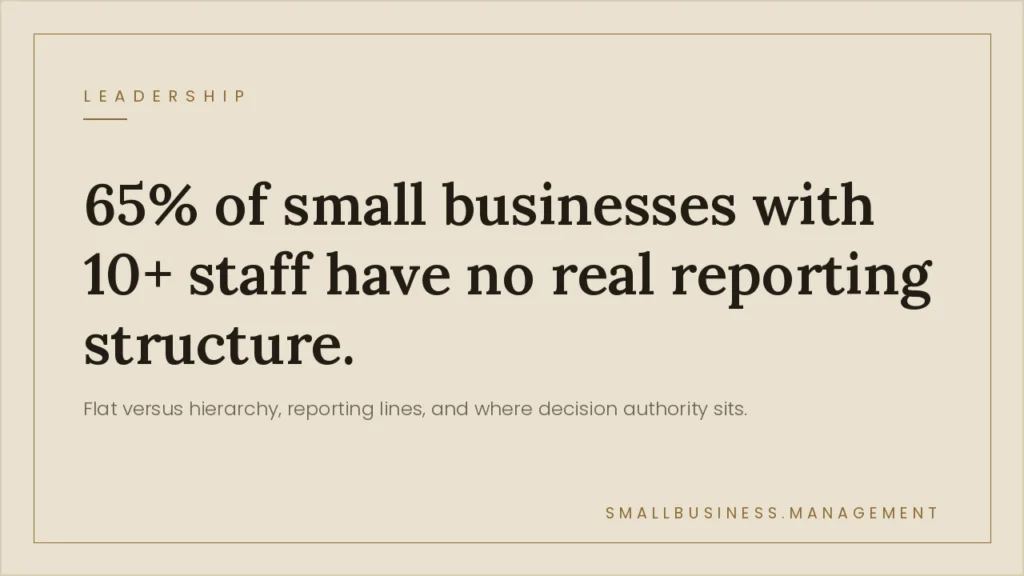
Small Business Organizational Structure: Flat vs Hierarchy, Reporting Lines, and Decision Authority

Most small businesses lack an organizational structure. They have an owner doing most things, a few employees doing the rest, and a set of informal reporting relationships that exist because of who was hired first, not because of any deliberate design.

This works when the business is small enough that the owner can hold it all in their head. It stops working when the business grows past the point where one person can oversee everything directly, when key people leave and their roles are unclear to others, or when the owner wants to step back from daily operations and realizes there is no structure to step back into.

Organizational structure is not about bureaucracy or org charts for their own sake. It is about defining who owns what, who makes which decisions, who reports to whom, and how the work gets coordinated as the business grows. Getting this right before it becomes a crisis is significantly less expensive than fixing it after.

Flat vs. Hierarchical: Choosing the Right Starting Point

The two structural options for a small business are flat and hierarchical. Most small businesses start flat and add hierarchy as they grow. The question is when and how to make that transition.

Flat Structure

A flat structure has one or two reporting layers: the owner and the team. Everyone reports either directly to the owner or to a single team lead. Decision-making is fast because there are no management layers. Communication is direct. The overhead of a management layer is absent.

Flat structures work well for businesses with fewer than 10 people, simple operations, and an owner who is actively involved in the work. The limitations appear as the business scales. An owner with eight direct reports is at or near the limit of what one person can effectively manage, especially if they are also doing strategic and sales work. When the team grows beyond that, the flat structure creates an overloaded owner rather than a managed business.

The other risk of flat structures is role confusion. Without clear reporting lines and decision authority, people either bring everything to the owner (creating a bottleneck) or make decisions independently, leading to inconsistent decisions (creating coordination problems). Flat structures require more explicit decision rights and role clarity to function well, not less.

Adding Management Layers

A hierarchical structure adds a management layer between the owner and individual contributors. The owner oversees two to four functional leads. Each lead manages a team in their area. Decisions are made at the appropriate level rather than escalated to the owner for everything.

For small businesses, the right time to add a management layer is when the owner has more direct reports than they can effectively support and develop, when a function has grown complex enough to require dedicated leadership, or when the owner needs to spend less time managing people and more time on strategy, sales, or external relationships.

The management overhead is real: managers cost money and add a layer of communication. The payoff is also real: a business with functional leads who own their domains can scale beyond what a single owner can oversee directly. The owner becomes a manager of managers rather than a manager of individual contributors.

Functional vs. Role-Based Structure

Functional structures organize the business by the work they do: operations, sales, finance, and customer service. Role-based structures organize around the people currently in the business, often resulting in job descriptions that reflect what one specific person happens to do rather than what the function requires.

Role-based structures are a trap. When a business is designed around current people, it becomes fragile when those people leave, promotes them to stay even when a different arrangement would be better, and makes it hard to hire because you are describing a role that fits one person rather than a function the business needs.

The right approach is to design a functional structure first, on paper, independent of who is currently in the business. List the functions the business requires: generating revenue, delivering the service or product, managing finances, handling operations, and managing people. Define what ownership of each function means. Then map current employees to those functions, accepting that some people will initially own more than one function. This gives you a roadmap for hiring that reflects what the business needs rather than who you currently have.

Reporting Lines: Who Decides What

Clear reporting lines answer two questions: who does each person go to for guidance and feedback, and who has the authority to make specific decisions?

Each person should have one primary manager. Dual reporting, where someone reports to two managers simultaneously, creates ambiguity about which direction to follow when they conflict. In small businesses, dual reporting is sometimes unavoidable, but it should be explicit about which manager is primary for performance conversations and priority-setting, and which is secondary.

Decision authority is separate from reporting lines but equally important. Define who can make which decisions independently versus who needs to escalate. A customer service lead should be able to resolve complaints up to a certain dollar threshold without owner approval. An operations lead should be able to approve routine vendor invoices without a sign-off. Defining these thresholds prevents both bottlenecks (where everything runs through the owner) and exposure (to critical decisions made without appropriate oversight).

In practice, many small businesses have implicit decision authority that nobody has ever discussed. The owner assumes they are consulted on certain decisions. Employees assume they have authority they may or may not have. Documenting decision rights eliminates the friction caused by misaligned assumptions.

Span of Control: How Many Direct Reports Is Too Many

Span of control refers to the number of direct reports a manager has. It matters because effective management requires time: performance conversations, goal-setting, coaching, removing blockers, and staying informed about how each person’s work is progressing. Each additional direct report consumes some of that time.

For an owner-operator also doing strategic work, sales, or client management, five to eight direct reports is near the practical maximum. Above that, either the management work becomes inadequate or the strategic work suffers. Both are costly.

For a frontline manager primarily focused on managing their team, six to twelve direct reports in similar roles is typically manageable. The number decreases as the complexity of each role increases. Managing a team of customer service representatives requires less individual attention per person than managing a team of senior engineers or account managers.

When an owner has 10 or more direct reports and is struggling to manage them all while also running the business, the solution is not to become a better manager. It is to add a management layer that reduces the owner’s span of control to a manageable number.

Removing the Owner from Daily Operations

The structural goal for most small business owners is to build an organization that does not require their daily involvement in operations. This is not about making the owner unnecessary. It is about building a business that can operate predictably and grow without the owner being a constraint.

The path requires three changes. First, functions need clear owners who are not the business owner. If the owner is the de facto head of sales, operations, finance, and customer service simultaneously, there is no structure to remove them from. Each function needs a person responsible for its performance.

Second, decision authority needs to be delegated to the function owners. If every decision above a trivial threshold still comes back to the owner, the functional structure is cosmetic. Real delegation means the operations lead can make operations decisions, the sales lead can make sales decisions, and the owner is involved in strategic decisions, not operational ones.

Third, reporting and accountability systems need to work without the owner as the primary information conduit. Weekly team meetings, functional dashboards, and documented processes allow the owner to stay informed without being present in every workflow. When these systems are in place, the owner can focus on the highest-value activities: strategy, key relationships, and the decisions that genuinely require their judgment.

For the operational systems that run alongside the organizational structure, see our guide to business operations management. For the strategic planning that defines what organizational structure is needed to support, see small business strategic planning. If you need outside help designing and implementing your organizational structure, businessadvisors.io works with small business operators on exactly that.

Summary

The organizational structure for a small business consists of four elements: defining who owns each function, establishing clear reporting lines with a single primary manager, assigning explicit decision-making authority at each level, and managing span of control so that no single person has more direct reports than they can effectively manage. Start with a functional structure designed around the work, not the current people. Add management layers when the owner’s span of control becomes a constraint on either the owner or the team. Build toward an organization that functions without the owner as the daily operational bottleneck.

author avatar
World Consulting Group
Scroll to Top