How to Reduce Vendor Costs: A Step-by-Step Guide for Small Business Owners

Vendor costs are one of the most controllable line items on a small business income statement. Most SMBs do not control them actively. Contracts auto-renew, prices drift upward with annual escalators, and the owner is too busy running the business to review the terms until the cost becomes painful enough to force attention.

This guide covers a structured approach to reducing your business’s vendor spend without damaging the relationships that matter and without requiring a procurement team to execute it. A business with 10 to 100 employees can run this process with one person and a few hours per month.

Why Vendor Costs Drift Upward Without Active Management

Auto-renewal clauses in vendor contracts are designed by the vendor, not by you. Most include annual price escalators of 3 to 8%, sometimes tied to CPI and sometimes not. After three years of auto-renewal, a contract that was competitive at signing may be 15 to 25% above market rate. The vendor has no incentive to tell you this.

The second driver of cost drift is scope expansion without price negotiation. As your business grows and vendor usage increases, the vendor charges for the additional volume at the list price rather than the discounted rate from your original negotiation. If you are buying more, you have more negotiating power, not less. Most SMBs never use it.

The third driver is redundancy. As businesses grow and add tools, they often end up paying for overlapping services from multiple vendors: two project management tools, three communication platforms, and redundant analytics subscriptions. No individual vendor relationship looks expensive. The total adds up to a number that would fund a hire.

Step 1: Build a Complete Vendor Inventory

Start by centralizing all vendor contracts and invoices in one place, then list every vendor the business pays: software subscriptions, professional services, suppliers, utilities, insurance policies, and any recurring service contract. Most SMBs have never done this comprehensively. The exercise typically surfaces three to five subscriptions that no one is actively using, and at least two vendors whose services overlap substantially with another vendor already on the list.

For each vendor, record: what you pay annually, what the contract term is, when the next renewal date is, who internally owns the relationship, and what you would do if the vendor disappeared tomorrow. That last question identifies which relationships are genuinely critical and which ones could be replaced or eliminated without operational impact.

Set a calendar reminder for 90 days before each renewal date. That is the window for renegotiation. After the auto-renewal date, you have already committed to another term. Before it, you have negotiating power.

Step 2: Benchmark Your Current Pricing

For each significant vendor relationship, determine the current market price for comparable services or products. Vendor spend benchmarking against external market data before renewals is the single most effective way to identify where you are being overcharged and to prepare specific, credible negotiation targets. For software, this is often available directly from the vendor’s public pricing page or from comparison sites. For suppliers and service vendors, it requires getting competing quotes.

Running a structured request for quotes with clear specifications, so vendors know they are competing, is more effective than casual inquiries. Getting three qualified quotes for every significant vendor relationship annually is a minimum standard. Not because you intend to switch every vendor every year, but because the act of getting quotes does two things: it tells you whether your current pricing is competitive, and it gives you negotiating information when you talk to your existing vendor.

Most vendors will offer a discount before losing an account. The discount is rarely offered proactively. It requires you to ask, and it helps to have a specific competing offer in hand when you ask. The conversation is straightforward: you have been a customer for X years, you have received a competitive offer at Y price, and you would prefer to stay with your current vendor if they can match or approach that rate.

Step 3: Consolidate Where It Makes Sense

Vendor consolidation, reducing the number of vendors in a given category, generates savings in two ways. First, it removes the fixed cost of managing multiple relationships. Second, it increases your purchasing power with the remaining vendor, which typically supports better pricing and service terms.

The categories where consolidation most commonly generates savings for SMBs are technology (software, IT support, communications), professional services (legal, accounting, HR), and supplies or materials with multiple small-volume relationships that could be combined into a single contract.

Consolidation is not always the right move. A dependence on one vendor in a critical category creates concentration risk. The question to ask before consolidating is whether a failure of a single vendor in that category would create an operational crisis. If so, maintain at least two qualified options, even if one is the primary. If no, consolidate and negotiate the volume rate.

Step 4: Renegotiate Before Every Renewal

Treat every contract renewal as a negotiation, not an administrative renewal. The preparation for a renewal negotiation takes less time than most business owners assume. Review the current contract terms, check market pricing, prepare a one-page summary of your account history (volume, payment record, length of relationship), and identify two or three specific changes you want: price reduction, better payment terms, additional capacity or usage at current pricing, or improved service levels.

The specific ask matters. “Can you do anything on price?” is a weak opening. “We have been a customer for four years, our volume has grown 40% over that period, and we have a competing offer at 18% below our current rate. We would like to bring our contract in line with current market pricing before we renew.” is a substantive opening that gives the vendor something specific to respond to.

Most vendors have more pricing flexibility than they initially indicate. The flexibility is unlocked by demonstrating that you have done the market research and that switching is a real option. When switching is clearly theoretical, vendors have little incentive to negotiate. When it is clearly credible, they have a significant incentive.

Step 5: Audit Service Usage Before Each Renewal

Before renewing any service contract, verify that the service is being used at the level you are paying for. Software subscriptions with unused seats, service contracts covering capabilities you no longer need, and insurance policies that have not been reviewed since they were first written are common sources of cost that persist because no one checks.

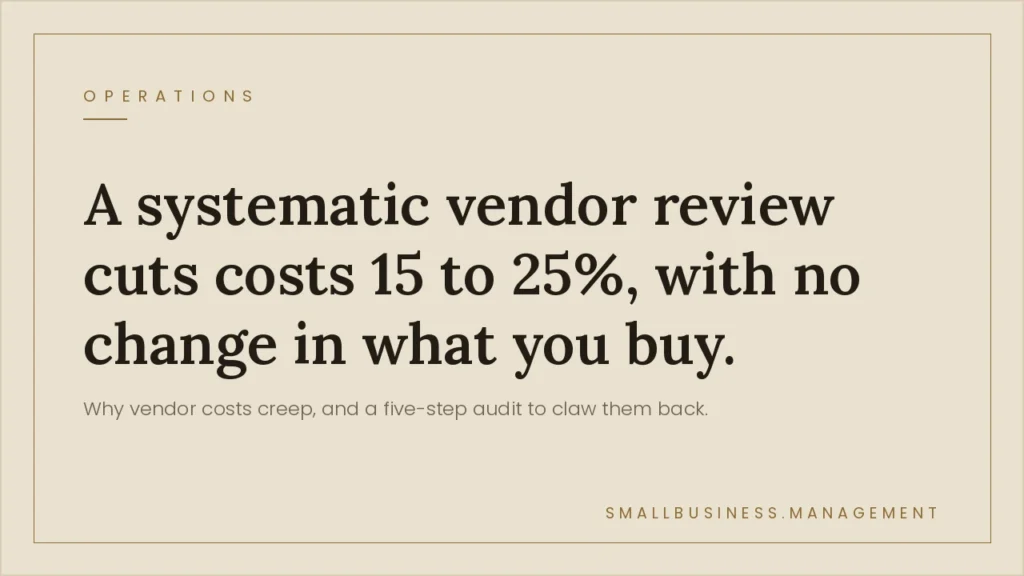
The usage audit for a software subscription is simple: pull the active user count from the admin panel and compare it to the seats you are paying for. Annual SaaS audits that remove unused seats, downgrade to lower tiers where the full feature set is not being used, and consolidate overlapping tools with a single provider typically generate 15 to 25% reductions in the software line without any change in operational capability. Inactive seats are a direct waste. Removing them before renewal, or requesting a seat reduction, is a straightforward request that most vendors accommodate.

The usage audit for a service contract requires reviewing what the contract covers against what you have actually used in the past 12 months. Scope you are paying for but not using is either a negotiating chip for a price reduction or a candidate for elimination from the renewal terms.

Step 6: Review Payment Terms

Payment terms and contract language are negotiating variables that most SMBs ignore. One tactic worth adding to any renewed contract: price-adjustment clauses tied to objective indices rather than vendor discretion. This means vendors cannot raise prices arbitrarily, and you have a mechanism to request reductions when underlying costs fall. Standard net-30 terms are not the only option, and they are not always the best option depending on your cash flow situation.

An annual prepayment often unlocks discounts of 10 to 20% with software vendors. If you have the cash and are confident in the vendor relationship, the $ 1,000-per-month discount is real money for a 15-minute conversation. Net-60 terms, which you can negotiate, improve cash flow flexibility at no direct cost.

Early payment discounts from suppliers, typically 1 to 2% for payment within 10 days rather than 30, are worth calculating against your current financing costs. In an environment where credit is expensive, capturing a 2% discount on early payments can yield a return higher than the cost of the capital used to fund the early payment.

Building a Vendor Management Routine

The businesses that keep vendor costs under control do not do heroic annual cost-reduction projects. The most effective ones standardize a simple vendor playbook: an RFQ template, a comparison matrix, a negotiation checklist, and standard contract terms that they apply consistently across renewals. This removes the dependence on any one person to run negotiations and ensures that every renewal receives the same structured treatment. They run a simple quarterly routine: review vendor inventory, check which renewals are due in the next 90 days, pull usage data for any subscription renewal, get at least one competing quote for any significant renewal, and schedule the renegotiation conversation.

Four hours per quarter is sufficient to run this process for most small businesses. The return on those four hours, in direct cost savings and in vendor relationships priced fairly rather than drifting upward on autopilot, typically exceeds the return on any other four hours the owner or operations manager spends in the quarter.

This is not procurement expertise. It is an operational discipline applied to a part of the business that most owners treat as a fixed cost. It is not fixed. It is a managed cost that responds to consistent attention.

When an Outside Review Makes Sense

An outside operations review is worth considering when vendor costs account for a significant portion of total operating expenses and the business lacks the internal bandwidth to run a structured vendor audit. An experienced advisor will identify redundancies, benchmark pricing against current market rates, and lead or co-lead renegotiation conversations on your behalf.

The return on a vendor cost review typically covers the advisory cost in the first year and generates ongoing savings in subsequent years. It is one of the clearest ROI cases for outside operational help.

World Consulting Group works with SMBs on vendor cost management as part of broader operations engagements. If your vendor costs feel out of control or you have not reviewed contracts in more than 18 months, start with an advisor conversation here.

Handling Difficult Vendor Conversations

Some vendor relationships are awkward to renegotiate because they involve people you know personally or businesses you have worked with for a long time. The professional approach is to separate the relationship from the transaction: be direct about what you need on pricing while being respectful about how you communicate it.

Most long-term vendors would rather keep your business at a lower margin than lose it entirely. The conversation that works is one that acknowledges the relationship, clearly states the business need, and gives the vendor a real opportunity to respond. What does not work is avoiding the conversation because it feels uncomfortable and then switching vendors quietly. That approach damages the relationship more than an honest negotiation would have.

If a vendor cannot meet a market-competitive price and you have a genuine alternative, switching is the right business decision. Make it cleanly, communicate professionally, and leave the door open for future work. Business relationships outlast individual contracts.

Monitoring After the Negotiation

The work does not end when the new terms are signed. Verify that the new pricing appears correctly on the first invoice after the renewal. Verify that any scope changes (seat reductions, service modifications) are reflected accurately. Vendor billing errors favor the vendor by default, not you. Catching them requires checking.

Set a quarterly reminder to review vendor costs against budget for each significant vendor relationship. If a vendor’s cost is increasing faster than the contracted rate, find out why before it compounds. Small billing errors left unchecked for 12 months add up to meaningful amounts. Catching them at 90 days is routine maintenance. Catching them at 18 months is a difficult conversation about credit and back-billing.

Vendor cost management is not a one-time project. It is an operational routine that runs permanently in the background. Built into the quarterly calendar and owned by one person, it generates consistent savings with minimal time investment. Left to auto-pilot, costs drift upward until they create a crisis that requires a scramble to fix. The choice between those two outcomes is a management decision, not a market outcome.

author avatar
World Consulting Group
Scroll to Top